
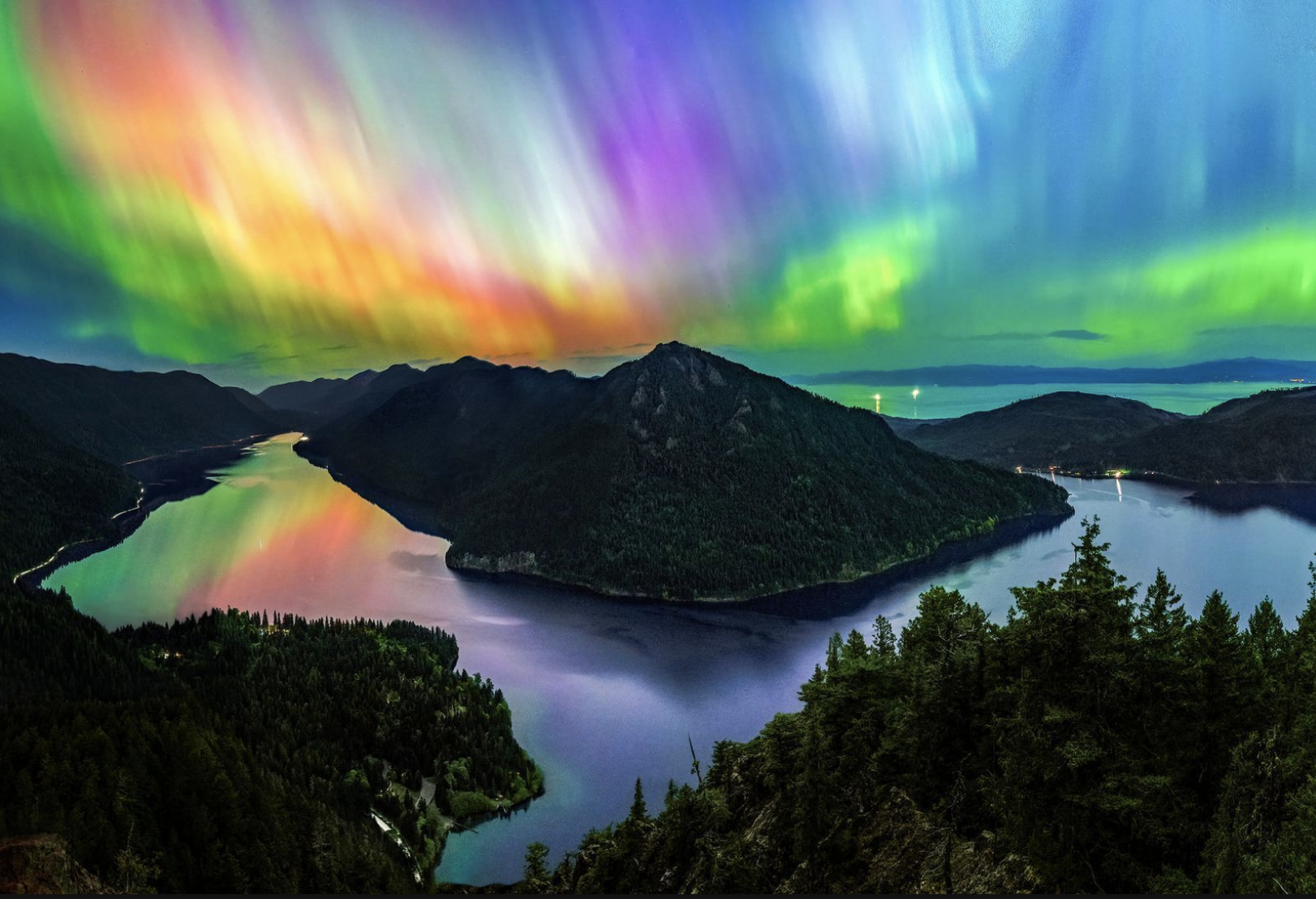
Whether you’re a long-time stargazer or just starting out, you’re in the right place. While stargazing is rooted in a philosophical experience for many, it also offers a sense of unexplainable wonder and contemplative peace for others.
After creating our first guide to sky events in 2022, we decided to publish a new guide annually. So, pack your binoculars, download a stargazing app (we like SkyView Lite and Star Walk 2), and bookmark this page. We hope this year’s guide offers a handful of events you won’t want to miss!

Why Is Lakedale An Ideal Place For Stargazing?
Our location on the San Juan Islands makes us a go-to spot for stargazing. And, with little light pollution here at Lakedale, one-of-a-kind sky shows are also easy to spot.
On top of that, nearly every room has a deck or viewing area, which makes it cozy (and convenient!) for you to stargaze from where you are. You can also gather in the Meadow or around one of the three lakes across our 82 acres.

2025 Eclipses, Meteor Showers, and Supermoons
Whether you’ve already witnessed a handful of eclipses, meteor showers, and supermoons, or you’re looking to catch your first one, we’ve got you covered!
Eclipses
Total Lunar Eclipse: March 13-14, 2025 | Peak: 11:58 p.m., March 13
The next Total Lunar Eclipse with a maximum view is right around the corner! It begins Thursday, March 13 at 8:57 p.m. and ends Friday, March 14 at 3 a.m.

Meteor Showers
Lyrids Meteor Shower: April 17-26, 2025 | Peak: April 21-22
A medium-strength shower, the Lyrids are best seen from the Northern Hemisphere where the radiant is high in the sky at dawn. These meteors usually last for an average of three nights and can produce fireballs.
Eta Aquariids Meteor Shower: April 20 – May 21, 2025 | Peak: May 3-4
North of the equator, the Eta Aquariids usually produce medium rates of 10-30 per hour just before dawn. These meteors produce persistent trains, but few fireballs.
Alpha Capricornids: July 12 – August 12, 2025 | Peak: July 29-30
While not as strong as other meteor showers, Alpha Capricornids shower produces a number of bright fireballs during its activity period.
Perseids Meteor Shower: July 17 – August 23, 2025 | Peak: August 12-13
Arguably the most popular meteor shower, Perseids are particles released from a comet during its numerous returns to the inner solar system. Note: The Gibbous Moon is predicted to compromise this meteor shower, with only the brighter meteors being visible.
Orionids Meteor Shower: October 2 – November 12, 2025 | Peak: October 22-23
A medium-strength shower, the Orionids can sometimes reach high-strength activity. Note: This year, a Crescent Moon will rise near dawn but is not predicted to affect the shower.
Southern Taurids Meteor Shower: October 13 – November 27, 2025 | Peak: November 3-4
The Southern Taurids is made up of two main components: the annual component (peaks October 14) and the fireball swarm (peaks November 4). 2025 is said to be a “swarm year.”
Northern Taurids Meteor Shower: October 13 – December 1, 2025 | Peak: November 8-9
Much like the Southern Taurids, the Northern Taurids shower is active later in the year.
Geminids Meteor Shower: December 1 – December 21 | Peak: December 12-13
Usually the strongest meteor shower of the year, Geminids provides good activity before midnight and is often bright and intensely colored.

Supermoons
Harvest Moon: October 6, 2025 | Peak: 11:48 p.m.
You don’t want to miss 2025’s first supermoon in October! This moon gets its name (Harvest Moon) because it appears near the autumnal equinox.
Beaver Moon: November 5, 2025 | Peak: 7:19 a.m.
This moon is uniquely named after beavers beginning to build their lodges to prepare for winter.
Cold Moon: December 4, 2025 | Peak: 6:14pm
The Cold Moon is the final full and supermoon of the year and is named after the cold temperatures of December.
 Thanks to Tyler Hartje for the incredible photo!
Where to Watch the Stars on San Juan Island
Looking to stargaze (and explore!) outside of Lakedale? With over 247 clear days and nights per year, the San Juan Islands are the perfect place to spot meteor showers, Northern Lights, and the most incredible full moons. Here are a few places we recommend checking out:
-
South Beach
South Beach is a must-see year-round. Before grabbing your favorite binoculars for stargazing, make sure to catch the sunset behind the snow-covered Olympic Mountains.
-
False Bay
After exploring the tide pools and searching for beach glass, take off your shoes and relax as you watch the moon reflecting on the ocean.
-
Dead Man’s Bay
Between watching the deer graze and seals pop in and out of the water, keep your eyes out for Orcas—a once-in-a-lifetime opportunity you don’t want to miss.
-
Mt. Young
If you enjoy stargazing mixed with adventure, take a three-mile hike up Mt. Young. The view at the top will be like nothing you’ve ever seen before!
 Thanks to Cameron Hein for the great photo!
Will the Northern Lights Return to San Juan Islands in 2025?
Wherever you are located, if you’ve experienced seeing the Northern Lights (also known as the Aurora Borealis), you know how unforgettable they are.
Staying at Lakedale in 2025? Make sure to add catching this spectacular light show to your list of things to do. The best time of year is from late September to late March (peak months between November and February!), between 10 p.m. and 2 a.m. local time.
Tips For Stargazing at Lakedale
- We have telescopes and stargazing charts at the front desk—stop by and ask us about them!
- Check the weather forecast before your arrival to see if you’ll have to deal with any cloud cover
- Keep your (warm) drinks of choice and snacks handy
- Grab chairs and blankets (we have a basket of Lakedale blankets in the Lodge right by the fire), bundle up, and head outside about 45 minutes before meteor showers peak so your eyes can adjust to the dark (supermoons and eclipses are exempt from this tip)
- Enjoy the show!
.If you’ve used our guides to book your time at Lakedale, we’d love to know! Tag us on social media (we’re @lakedaleresort on Instagram and Facebook) so we can add some love to your stargazing San Juan Island adventure. And, if you have requests for upcoming guides, please don’t hesitate to reach out and ask for them. Or, you can wish on a star, but make sure you tell us, too.
(And a photo shoutout to Matthew Nichols for the top image of the Aurora Borealis over the San Juan Islands!)

Thanks Wagsphoto for this stunner!